Right now is the part of the year that decides next season, and most goalies spend it doing nothing at all.
Adaptive Goaltending Academy trains lacrosse goalies. We work one on one online, in small groups and clinics across Utah, and inside high school, club and college programs. Everything we teach runs on one framework: Pre-Shot, The Move, The Finish. Most goalie instruction starts at The Move. Almost every problem we see starts before it.
I’m Coach Connor Hollison. I played five years in goal at the University of Utah, as well as IMG Academy and currently play for the Argentina National Team, and I wrote The Modern Lacrosse Goaltender and The Fearless Lacrosse Goalie. I coach goalies full time, which mostly means I spend my days watching the same handful of fixable mistakes over and over.
This post is for the goalie who wants to show up in February different from how they finished in June, and for the parent or coach holding them to it. You are getting the actual week: four sessions, about forty five minutes each, two of which can happen at home. What to train in each one, what to skip, and the two jobs that belong to the adult rather than the athlete.
What should a lacrosse goalie do in the off-season?
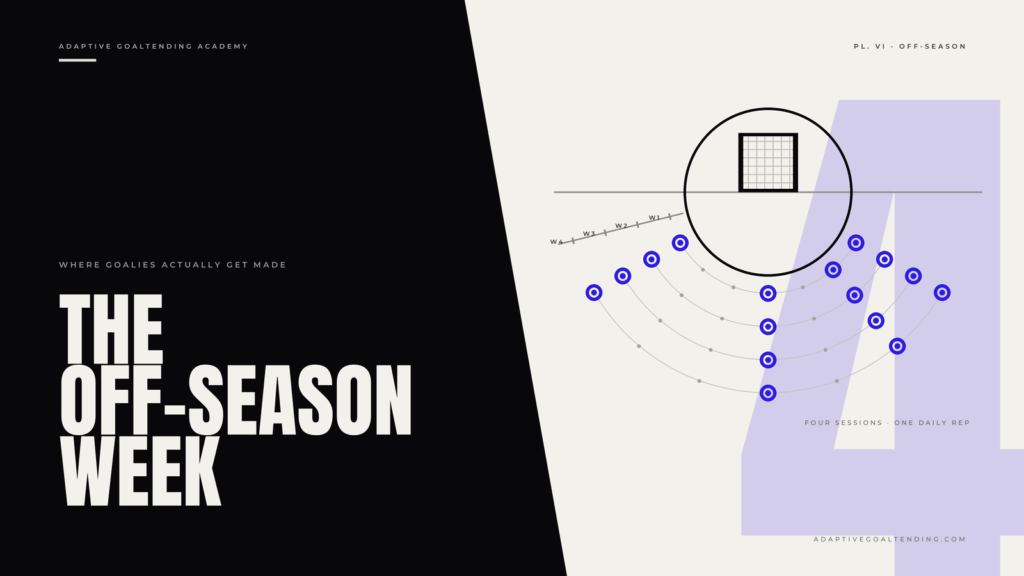
Four things on a weekly rhythm: wall ball and hands, movement and strength, on field technical work, and clearing. About three hours a week across four days. Short enough to survive basketball season and homework, long enough that a goalie shows up in February noticeably different.
Why November through February matters more than the season
During the season a goalie faces a lot of shots and improves almost none. There is no room to change anything. You play Tuesday, practice Wednesday, play Friday. Every rep is a performance rep.
The off-season works the other way. Nothing is on the line, nobody is watching, and a change made in December has twelve weeks to become automatic before it has to hold up in a game. The same fix attempted in March takes a full season to stick. Started in December, it is holding by the first scrimmage.
That gap is the cheapest competitive advantage available in this sport, and it is sitting there every winter because most goalies do not use it.
The week
Four days. Roughly forty five minutes each. Two of them can happen in a driveway.
Day 1: Wall ball and hands, 40 minutes
Fifteen minutes of wall ball. This is not optional and it is the thing goalies skip most, because it feels like a field player’s drill. It is not. A goalie’s outlet pass is half their job and it is the first skill to decay when the season ends.
Then twenty five minutes of hands and eyes. Partner ball drops, ping pong soft toss, reaction ball off the wall, juggling. Small balls, high rep counts.
Day 2: Movement and strength, 45 minutes
Lower body and core work plus goalie specific footwork. Lateral bounds, single leg jumps, lateral box jumps, ladder work, low shot shuffles.
For a youth goalie, bodyweight is enough and it is the right call. There is no version of this where a twelve year old needs a barbell. For a high school goalie already lifting with their team, the goalie specific addition is single leg power and lateral explosiveness, which most team programs under train.
The point of this day is not strength for its own sake. A goalie who can hold a loaded stance for five minutes without their hips collapsing has better technique in the fourth quarter than one who cannot.
Day 3: On field technical, 45 minutes
The only day that needs a cage and a shooter.
Pick one thing for the month and work only on it. Not four things. One. Stance and stillness in December, hand path in January, positioning in February, or whatever your goalie’s actual weakest link turns out to be. Twenty minutes on that single item, then twenty five minutes of live reps at a pace they can save.
Day 4: Clearing and conditioning, 35 minutes
Clearing to corners, cross bar drill, long toss. Add a rider in the last ten minutes.
This is the day most goalies cut, and it is the one that shows up most visibly in March, because every coach notices the goalie who can hit a midfielder in stride.
And one mental rep, every single day
Not a session. A rep.
Pick a reset cue, which is one physical action, the same one every time, that ends the last play. Tapping both pipes. Pressing a spot on the glove. Spraying the water bottle and tracking a droplet to the ground.
Then run it on every mistake in every training session all winter. Every missed catch in wall ball, every dropped ball drop, every goal in live reps.
You are not building a habit for games. You are building one deep enough that a fourth quarter goal in a tied game cannot override it. A reset cue that was never trained in practice will not fire under pressure, and the goalie will decide the tool is broken when the truth is they never installed it.
What to skip
Do not chase volume. A hundred unstructured shots is worse than thirty structured ones, because the hundred reinforce whatever habits are already there.
Do not fix four things at once. Pick the earliest failure in the save process and give it a month. Stance problems create stillness problems, and stillness problems create hand path problems. Working on hand path while stance is broken is wasted effort.
Do not train through a full second sport without adjusting. A goalie playing winter basketball is already getting movement and conditioning. Cut Day 2 and keep the other three.
For coaches and parents: your actual job here
You are not running this. Your goalie is. (Coaches, the in-season version of this lives in the 20-minute goalie block.)
Your job is two things, and both are administrative rather than technical.
Protect the calendar. Four forty five minute blocks a week only survives if somebody defends it. Most off-season plans die in week three because nothing was ever written down.
Ask about process, not results. “Did you get your four days?” is a better question than “are you getting better?” One of them has an answer.
Start by finding the weak link
Everything above depends on knowing which part of your goalie’s game is actually costing them goals. Guessing wrong means spending the whole winter on the wrong thing.
The Goalie Self-Scout is a free scored assessment that tells you where they sit and what to work on first. It takes about five minutes and you will get the answer before you plan a single session.
Have Any Questions ?
We know every goalie’s journey is different. If you have questions about training, packages, or what’s best for your game, we’d love to help.