How do you know what to work on as a lacrosse goalie?
Most goalies train whatever they’re already good at, because it feels better. The fastest way to improve is the opposite: find the single weakest link in your save process and attack it for four weeks. Everything else can wait.
The nine areas below cover the full position – technical, tactical and mental. Each one has a self-test you can run today. Be honest. The point of an audit is to find the thing you don’t want to find.
1. Stance and weight distribution
Self-test: Hold your game stance for five minutes without shifting or breaking.
If you can’t, your weight distribution is inefficient, and that inefficiency shows up as fourth-quarter fatigue and as small unnecessary movements on every shot before that. Hips back and loaded, chest up, weight through the middle of the foot.
2. Stillness before the shot
Self-test: Have a shooter fake for a full five count before shooting. Ten reps. Count how many times your feet move before the ball is released.
This is the one that decides most games. If your feet are moving during the fake, you’re committing to locations before you have information. Anything above one or two out of ten is a red flag, and it’s your priority over every other item on this list.
3. Ball focus
Self-test: After the next shot you face in practice, ask yourself honestly: were you watching the ball, or were you watching the shooter?
Reading shoulders, hips or eyes feels sophisticated and is a fast route to guessing. Your eyes belong on the ball from the moment it enters your vision until it’s in your stick or past you.
4. Hand path
Self-test: Film yourself facing ten off-stick shots from the side. Watch whether your shoulders rotate before your hands move.
If the shoulders go first, your stick gets trapped behind your body and the save becomes impossible regardless of how fast you are. The top hand leads, shoulders stay square, the stick drives to the ball.
5. Low shots
Self-test: Ten low shots, stick side and off side. Count how many times your hands drop before your feet move.
Dropping the hands first collapses your balance and opens the entire top half of the cage on any rebound or second shot. Hands drive down in a controlled line, chest stays up, lateral step to the ball.
6. Positioning on shots on the run
Self-test: Have a shooter dodge from up top toward the alley and shoot on the move. Five reps each side. Are you set and still at the moment of release, or still adjusting?
Your arc position updates as the shooter moves, but every update has to finish before the shot. Goalies who move with the shooter through the release get beat near post almost every time.
7. Crease saves and 1v1
Self-test: Twenty 1v1s from the crease with a shooter who’s allowed to fake. Count how many times you moved before they shot.
On a 1v1, the goalie who moves first loses. Match the shooter’s stick head with your own and force them to commit before you do.
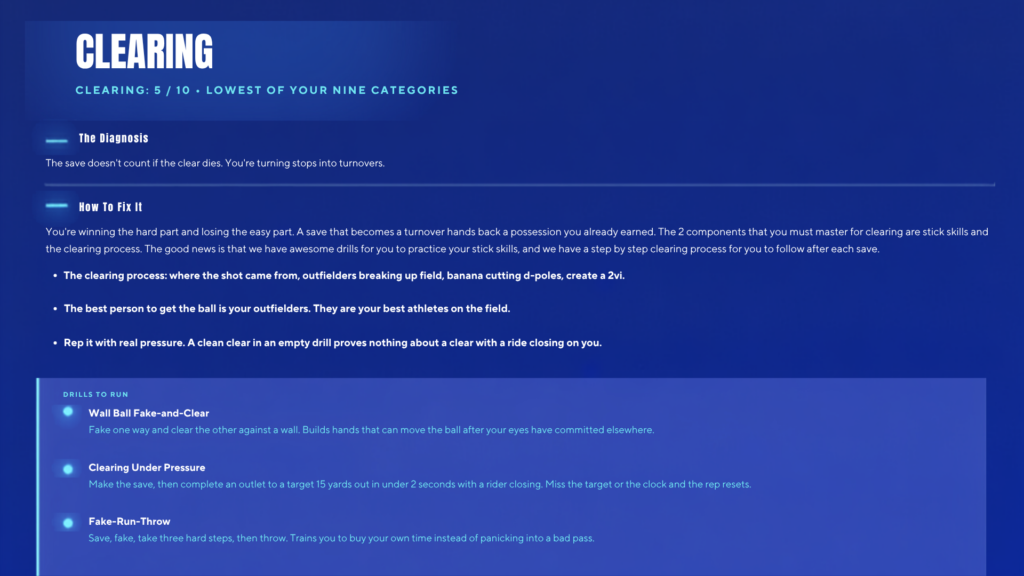
8. Clearing
Self-test: Ten saves, each followed by a turn, a scan and an outlet to a target 30+ yards away. How many are clean and on time?
A save is half the job. Most goalies have never repped the outlet under pressure, which is why possessions die at the restraining line.
9. The mental reset
Self-test: Name your reset cue right now, without thinking about it.
If you had to think, you don’t have one. A reset cue is one physical action you run after every goal to end the play mentally, and it has to be trained in practice before it will fire in a game.
What to do with your results
You will probably find three or four weak spots. Do not try to fix all of them.
Pick the earliest one in the save process, the lowest-numbered item on this list that you failed. Stance problems create stillness problems, stillness problems create hand path problems, and so on down the chain. Fixing item 4 while item 2 is broken is wasted work.
Give that one item four weeks of deliberate attention. Re-run the audit at the end.
Get the scored version
The nine questions above are the short version. The full Goalie Self-Scout walks you through a scored assessment and tells you exactly where you sit and what to work on first. It’s free and takes about five minutes.
Run the Self-Scout: https://adaptivegoaltending.com/self-scout/
If you want a second set of eyes on your actual film rather than a self-assessment, that’s what one-on-one sessions are for. We look at three things first: stillness before the shot, balance in your stance, and positioning on shots on the run.
Book a technical session: https://adaptivegoaltending.as.me/?appointmentType=89037670
In-person in Utah this fall:
Small group block — Kaysville. September 14, 21, 28 and October 5, 5:30–7:00pm. Six goalies max, $250 for the block. adaptivegoaltending.systeme.io/small-group-1
Saturday clinics — Salt Lake City. October 24, November 14, December 12. Fifteen goalies per clinic, $175 each or $450 for all three. adaptivegoaltending.systeme.io/fall-clinics
Have Any Questions ?
We know every goalie’s journey is different. If you have questions about training, packages, or what’s best for your game, we’d love to help.