Why do lacrosse goalies get beat on shots they should save?
Because they moved before the ball was released. Pre-release movement is the single worst habit a lacrosse goalie can develop, and it is the root cause behind a large share of the goals that look like reaction-speed problems. When a goalie commits to a location before the shot leaves the stick, they have handed the shooter the rest of the net. No amount of hand speed recovers from a body that is already going the wrong way.
This is the hardest idea to sell to a goalie, because moving feels like effort and stillness feels like doing nothing. It’s backwards. Stillness is the hardest physical skill in the position, and it is the one that separates goalies at every level above youth.
The math of a lacrosse shot
A shot from twelve yards at 80 miles per hour reaches the goal line in roughly a third of a second. Human visual processing plus motor response takes somewhere in the range of 200 milliseconds before your body produces meaningful movement.
That margin is thin, and it’s why so many goalies conclude that they need to start early to make up the difference. It’s the wrong conclusion. Starting early doesn’t buy you time, it spends your one guess before you have any information. Being still and balanced doesn’t add milliseconds to your reaction; it makes every millisecond you have actually usable, because your first movement goes toward the ball instead of correcting a mistake.
Elite goalies are not faster than everyone else. They are quieter than everyone else, and their first movement is always the right one.
What “still” actually means
Still does not mean frozen. It means no unnecessary movement in the window between the shooter loading and the ball leaving the stick. Specifically:
- Feet quiet. No shuffling, no bouncing, no stutter step as the shooter winds up.
- Head level. Your eyes are a camera. A moving camera produces a blurry image.
- Hands in position and not drifting. Hands that pre-load toward a corner have already picked a side.
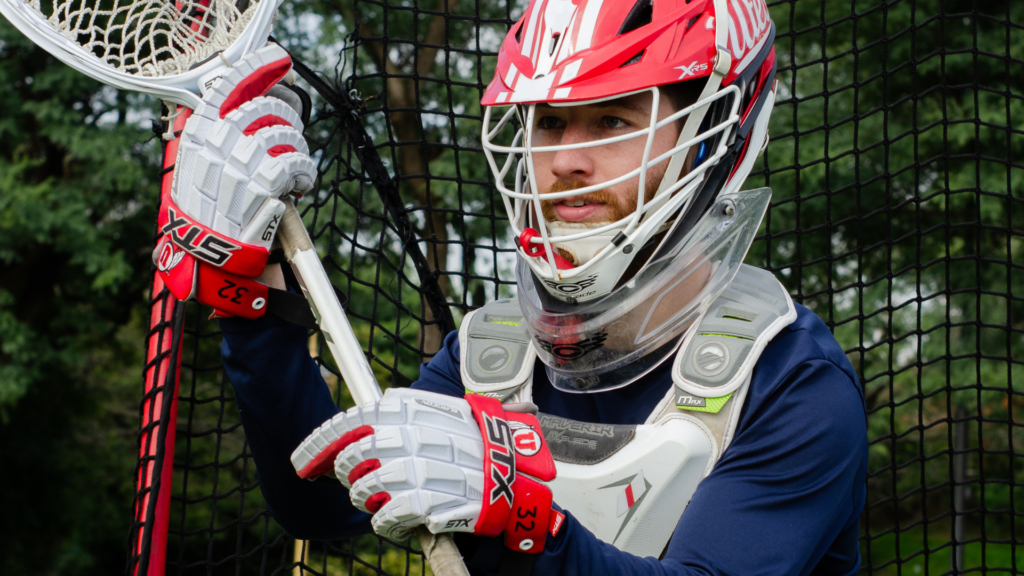
- Hips loaded and back, like you’re sitting on a barstool. This is the position that lets you explode without a preparatory movement first.
If you cannot hold your stance comfortably for five minutes, your weight distribution is inefficient. That inefficiency shows up as fatigue in the fourth quarter and as unnecessary movement on every shot before that.
Watch the ball, not the shooter
This is where we differ from a lot of goalie coaching, and it’s deliberate.
You will hear that you should read the shooter’s shoulders, hips, or eyes to anticipate where the shot is going. At the highest levels, shooters know this and use it against you. More importantly, anticipation is a form of pre-release movement: it’s the mental version of the same mistake. The moment you decide where the ball is going before it’s released, you’ve stopped tracking and started guessing.
Your eyes go to the ball and stay on the ball. From the moment it enters your field of vision to the moment it’s in your stick or past you. That’s it. Every cue you actually need is carried by the ball.
This is also the fastest fix available to most goalies, because it costs nothing to implement and it starts working immediately.
The save process: Pre-Shot, The Move, The Finish
Stillness is not a standalone tip. It’s the first phase of a three-part sequence, and it’s the phase that determines whether the other two are even possible.
Pre-Shot. Arc position, balanced stance, hips loaded, eyes on the ball, completely still. Everything that decides the save happens here. If your Pre-Shot is wrong, the best hands in the world can’t save you.
The Move. One movement, driven by the top hand, with the body following the hands to the ball. Shoulders stay square. The lead foot steps toward the ball, not across your body. There is no second correction, you get one move.
The Finish. Hands through the ball, not at it. Body behind the stick where possible. Then immediately: control the rebound, or turn and clear.
Goalies who obsess over The Move are usually trying to fix a Pre-Shot problem with a Move solution. It doesn’t work.
Three drills that build stillness
- The Five-Count Fake. A shooter loads up and fakes for a full five count, then shoots. Your only job is to stay completely still and balanced through the fake. Ten reps. This is the highest-value drill in this entire article, it requires nothing but a shooter and a ball, and it directly attacks the habit.
- Mirror Hold. Hold your stance in front of a mirror or a phone on a tripod for two minutes, then five. Watch for drift (the slow collapse of your hips, the hands sinking, the weight shifting to your heels). Most goalies have never seen their own stance decay in real time, and it is a genuinely uncomfortable thing to watch.
- Ball-Only Tracking. A partner shoots from short range standing partly behind a screen, so you cannot read their body. You have only the ball. Twenty reps. This drill makes ball-focus feel normal rather than like something you’re forcing.
Run all three twice a week for a month. It’s about twenty minutes per session and it will do more for your save percentage than a hundred additional shots.
What stillness looks like in a game
You will know it’s working when 1v1s from the crease stop scaring you. On a 1v1, the goalie who moves first loses, full stop. A shooter with the ball in tight is looking for you to commit so they can go the other way. The goalie who stays patient, matches the shooter’s stick with their own, and waits for the actual shot makes a save that looks impossible from the sideline.
Same principle on shots on the run. As the shooter moves along the arc, your positioning updates — but every update finishes with you set and still before the release. Moving with the shooter through the shot is how goalies get beat near post.
Where to go from here
If you want to know which part of your process is actually costing you goals, start with a self-assessment rather than guessing: https://adaptivegoaltending.com/self-scout/
If you want eyes on your actual film, technical sessions are one-on-one and built around the Pre-Shot, Move, Finish sequence.
Book a technical session: https://adaptivegoaltending.as.me/?appointmentType=89037670
In-person in Utah this fall:
Small group block — Kaysville. September 14, 21, 28 and October 5, 5:30–7:00pm. Six goalies max, $250 for the block. adaptivegoaltending.systeme.io/small-group-1
Saturday clinics — Salt Lake City. October 24, November 14, December 12, 10:00am–1:00pm. Fifteen goalies per clinic, $175 each or $450 for all three. adaptivegoaltending.systeme.io/fall-clinics
Have Any Questions ?
We know every goalie’s journey is different. If you have questions about training, packages, or what’s best for your game, we’d love to help.