How do you coach a lacrosse goalie if you never played the position?
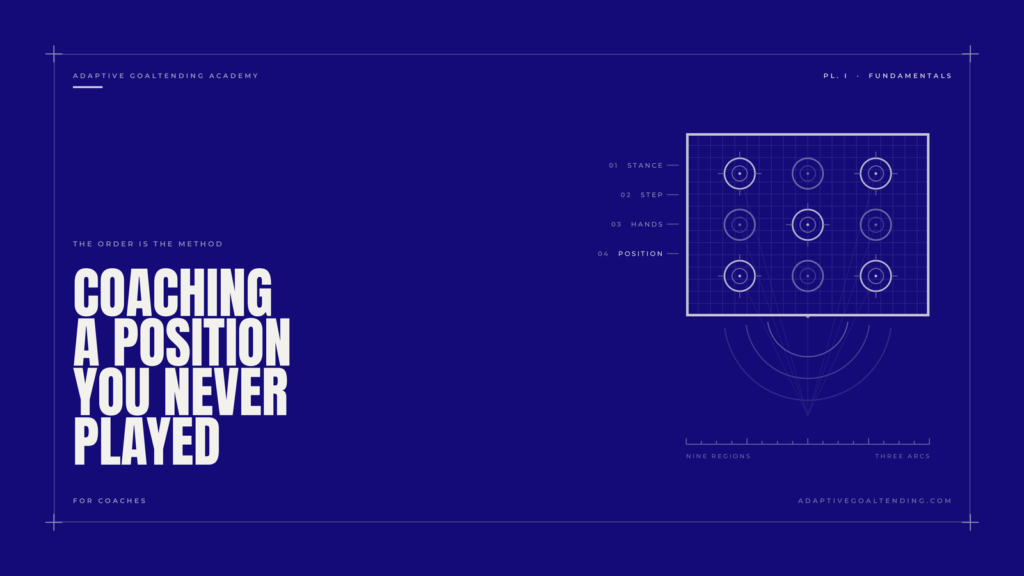
You teach four things, in this order: stance, stepping to the ball, moving the hands correctly, and positioning. If you only had fifteen minutes with a brand-new goalie, you’d spend it on the first three. If you had another fifteen, you’d spend all of it on positioning, because just standing in the right part of the cage increases the odds of a save exponentially.
That’s the whole curriculum for a new goalie. You don’t need to have played the position to run it.
The minimum before a kid steps in the cage
At a bare minimum, any goalie stepping into the cage must go through one team practice with at least 30 minutes set aside for fundamentals.
This is not a nice-to-have. Putting an untrained kid in the cage and letting the team rip shots at them is dangerous, and it’s the single fastest way to guarantee they never play the position again.
The four fundamentals, in order
- Stance. Without a proper stance, a goalie cannot learn any other skill. Knees bent, athletic, hips back, chest big and square to the shooter, stick head flat to the shooter at a workable angle.
- Stepping to the ball. The step is what gets the body behind the shot. A lead step wider than the path of the shot, hips square through the whole save. A goalie who reaches instead of steps is covering a fraction of the cage they think they are.
- Moving the hands correctly. Both hands drive to the ball, top hand in a straight line. This is what produces quicker hands and controlled rebounds.
- Positioning. The highest-leverage skill in the position and the one youth coaches skip most. A goalie standing in the right spot makes saves without doing anything athletic. A goalie out of position has to be spectacular just to break even.
What does a goalie warm-up look like when you only have five minutes?
Five minutes, 8–10 yards out, shooting at 60–70% speed. Ideally with two shooters so the goalie also practices positioning, ball tracking, and moving between spots.
The sequence:
- 10 shots anywhere high
- 10 shots anywhere mid
- 10 shots anywhere low
- 5 shots anywhere
- 10 shots anywhere on the crease. Make them saveable
That’s a real warm-up between games at a tournament. Notice what it is not: a line of kids ripping full-speed shots at a cold goalie. Sixty to seventy percent is the number. Speed is not what warms a goalie up; tracking and movement are.
Which drills should the goalie be in?
Include your goalie in any drill where the shot is realistic and reasonably safe, and where they have an actual chance at the save.
Include goalies in:
- Stepdowns from 8–10 yards out (closer to 12 for high-level shooters)
- Crease finishes, only if your shooters are capable of not crease-cranking and the goalie has a chance
- Even-number drills
- Odd-number drills
- 6v6
- Anything involving clearing
Do not include goalies in:
- Midrange shooting from 4–7 yards, unless you’re using a soft ball or a tennis ball
- Any drill where a crease crank is likely — especially at the youth level
- Crease finishes where the goalie has virtually no chance of saving the ball
The test is simple: if the goalie has no realistic chance at the save, they are not training, they are a target.
How do you split reps between two goalies?
Give them a system, and let them run it themselves if they can. If they aren’t sorting it out, set the number; switch every 3 reps, or every 5.
If a goalie is solo, especially a new one, let them step in for 3–5 shots and step out for 3–5 if that makes them more comfortable. A new goalie who is allowed to breathe stays in the position.
What are the standards for a goalie at practice?
The same standards as everyone else on the team. Goalies run between drills, communicate consistently, and train at maximum effort.
Practice is also where all the coaching happens:
- Include goalies in team drills whenever possible.
- Avoid telling goalies to “go do their own thing.”
- Set aside time at the beginning of practice for goalie-specific training.
- Training should follow a clear plan, not random reps.
- There should be an assistant coach assigned to conducting goalie training.
That last one is the cheapest fix on this list and almost nobody does it. One assistant, one job.
When should you coach your goalie during a game?
Almost never. During games, the best approach is usually to leave your goalie alone.
The position is already mentally demanding and already carries significant pressure. Constant coaching or feedback mid-game adds load to a player who has none to spare. Speak up only if something is clearly out of line; otherwise let your goalie handle the game the way they need to in order to win.
Positive reinforcement is the exception, and you should be doing it. Cheer great saves, great clears, every good play. Get the bench in on it too.
Pre-game, three rules: let goalies run their pre-game routine without interruption, keep them in team drills like any other player, and give them a dedicated warm-up window of 5–10 minutes minimum.
If your goalies need a professional eye:
We offer 1on1 online training. We’ve worked with dozens of goalies in this format for almost 2 years and are confident in its effectiveness for goalies of all skill levels. You can learn more about how this works here: https://adaptivegoaltending.com/virtual-training/
We also offer virtual team goalie training, please contact us directly and we will schedule a call to find the right setup for your team: email connor@adaptivegoaltending.com for more information.
Skeptical? See what other families and teams have to say: https://share.google/spgcNKvLlna9tXGQA
Have Any Questions ?
We know every goalie’s journey is different. If you have questions about training, packages, or what’s best for your game, we’d love to help.