Most parents of goalies want to help and have no idea how. The position looks technical, the gear is confusing, and the last thing you want is to teach your kid something wrong that their coach then has to undo.
Adaptive Goaltending Academy trains lacrosse goalies. We work one on one online, in small groups and clinics across Utah, and inside high school, club and college programs. Everything we teach runs on one framework: Pre-Shot, The Move, The Finish. Most goalie instruction starts at The Move. Almost every problem we see starts before it.
I’m Coach Connor Hollison. I played five years in goal at the University of Utah, as well as IMG Academy and currently play for the Argentina National Team, and I wrote The Modern Lacrosse Goaltender and The Fearless Lacrosse Goalie. I coach goalies full time, which mostly means I spend my days watching the same handful of fixable mistakes over and over.
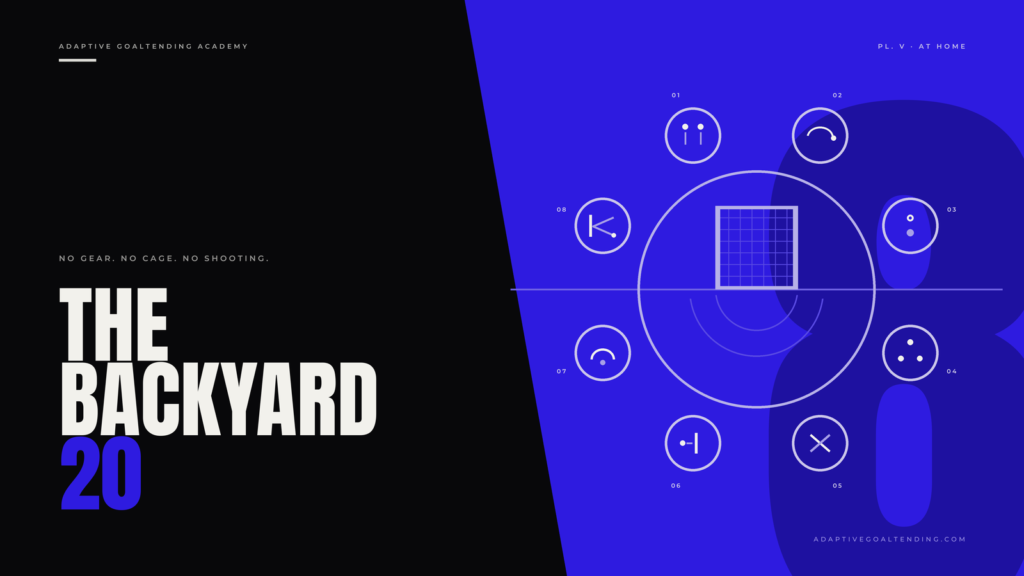
Here is the good news for you. One of the most valuable things a young goalie can train is hands and eyes, and that is the part you can run in a driveway with a few balls. You will not be coaching technique anywhere in this post. You will be running eight drills, twenty minutes twice a week, all of them safe, none of them needing gear, and every one of them building the foundation of every save your goalie will ever make.
How can a parent help a lacrosse goalie if they never played?
Train their hands and eyes instead of their technique. Reaction, tracking and hand eye coordination sit underneath every save in the position, and all of it can be worked with tennis balls, ping pong balls and a wall. No helmet, no cage, no shooting, and no knowledge of goalie mechanics on your part.
Twenty minutes, twice a week. Pick four of the eight below.
The rule before any of it
Never throw a real lacrosse ball at your goalie unless they are in full gear and warmed up. Not in the backyard, not “just a few soft ones.”
Flinching is biology, not a character flaw. It is a normal reflex doing exactly what it is designed to do, and the fastest way to build a flinch that takes two years to undo is to put a kid in front of a hard ball before they are ready for it.
1. Partner ball drops
Hold two balls out in front of you, palms down. Your goalie rests their hands lightly on top of yours. Drop one or both at random and they catch it before it hits the ground.
Thirty reps. Progress it by adding fakes and hesitations, and by having them start with their hands at their sides so they have to catch palm out, which is the same hand position as a real high save. Watch the drill
This is the best drill on the list for teaching patience.
2. Ping pong soft toss
Stand about eight feet away and soft toss ping pong balls to different spots. They catch with the top hand only. Watch the drill
Thirty reps. A ping pong ball is small enough and erratic enough that it forces real tracking. You cannot catch one on autopilot.
3. Tennis ball penny drop
Balance a penny on top of a tennis ball. Drop the ball, the penny pops up, and they catch the penny. Two balls and two pennies once that gets easy. Watch the drill
20 reps. It looks like a party trick. It is high level hand eye work.
4. Juggling
Teach them to juggle three balls. 20-30 minutes a day for two weeks and most kids have it.
Nothing on this list builds hand eye coordination faster for less equipment, and it is the one they will keep doing on their own because it is fun. Watch the drill
5. Scissors
A hand eye drill where they switch which hand crosses over the top on each rep. Watch the drill
Two minutes, continuous.
6. Tennis ball chest saves
Toss tennis balls at chest or stomach height, left or right. No stick, and no hands allowed. They have to step and use their chest. Watch the drill
Twenty reps.
This is the one drill on the list that exposes technique, and you do not need to know anything to see it. Watch whether they take a wide step toward the ball with their hips staying square to you, or whether they turn sideways and reach. Turning is the error. You do not have to fix it. Just tell them what you saw and let their coach handle the rest.
7. Reaction ball self toss
Your goalie throws a reaction ball off a wall to themselves and makes the save with the top hand only. A reaction ball is the lumpy rubber one, around ten dollars, and it bounces off at an angle nobody can predict. That is the whole point of it.
Because they are throwing it themselves, they control the pace, which is what makes this safe to run without a helmet. Watch the drill
Two minutes, continuous. This is the closest thing on the list to a real shot. Watch whether the top hand drives to the ball or drifts toward where they expected it to go.
You can pick up a reaction ball here.
8. Cone stepping build-up
The only drill on the list with no ball at all, and the one that will do the most for your goalie’s footwork.
Put a cone about four to six inches outside each foot. Then work through it in two stages:
- 10 jab steps right, 10 jab steps left. A short step out toward the cone and back. Pause between reps rather than rushing them.
- 10 full steps right, 10 full steps left. A full wide lead step, pushing off the back foot, finishing with the cone in the middle of their feet.
Forty reps total. Hips stay square to the front the whole way through on every rep.
Watch for the back foot dragging instead of coming off the ground. That is the most common fault here and it is the one that makes a goalie slow without them knowing why.
Amazon Associate Disclaimer: As an Amazon Associate I earn from qualifying purchases.
How to structure the twenty minutes
Pick four. Two from the first five, which are pure hands and eyes. Then the chest saves or the reaction ball. Then the cone stepping to finish, because footwork is the one thing on this list that does not get trained anywhere else.
Run the same four for two weeks so they can feel themselves improving, then rotate. At this age consistency beats variety by a wide margin.
Where this stops being enough
Hands, eyes and reaction you can train in a driveway forever. Stance, hand path on off stick shots, arc positioning and crease play need someone who has played the position, and trying to teach those from a parent’s chair often causes more harm than gain.
If you want to talk through where your goalie actually is and what they should be working on, book a parent call with me. We go through what you are seeing, I tell you what it usually means, and you get a straight answer on what would help and what would be a waste of money. No obligation attached to it.
Have Any Questions ?
We know every goalie’s journey is different. If you have questions about training, packages, or what’s best for your game, we’d love to help.