Most youth and high school goalies get one kind of training at practice, and that is people shooting at them. It is rarely anyone’s fault. Almost nobody coaching lacrosse played the position, so the goalie ends up with the only thing everyone knows how to give.
Adaptive Goaltending trains lacrosse goalies. We work one on one online, in small groups and clinics across Utah, and inside high school, club and college programs. Everything we teach runs on one framework: Pre-Shot, The Move, The Finish. Most goalie instruction starts at The Move. Almost every problem we see starts before it.
I’m Coach Connor Hollison. I played five years in goal at the University of Utah, as well as IMG Academy and with the Argentina National Team, and I wrote The Modern Lacrosse Goaltender and The Fearless Lacrosse Goalie. I coach goalies full time, which mostly means I spend my days watching the same handful of fixable mistakes over and over.
This post is for the coach who has a goalie and is not sure what to do with them. You do not need to have played the position. What follows is a twenty minute block you can run at practice twice a week: four segments, what to watch for in each one, and the one sentence to say when it goes wrong. One coach, one shooter, a bag of balls and a few tennis balls. By the end of this page you will be able to run it tomorrow.
What should a coach run with their goalie at practice?
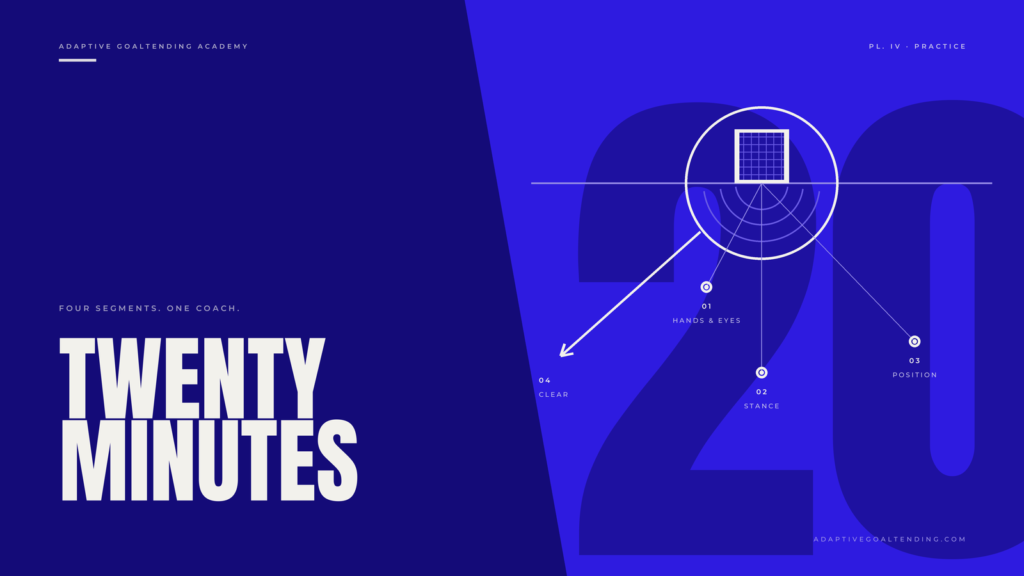
Twenty minutes, split into four five minute segments: hands and eyes, the goalie warm-up, a live drill built around your goalie’s current weakness, and clearing. Run it at the start of practice rather than the end, and run the same four segments every time so your goalie can measure themselves against last week.
That is the whole curriculum. Nothing in it asks you to diagnose goalie technique. Each segment asks you to watch for one specific thing and say one specific sentence.
Minutes 0 to 5: Hands and eyes
What you run. Partner ball drops. Stand in front of your goalie holding two balls palms down, with their hands resting lightly on top of yours. Drop one or both at random and they catch it before it hits the ground. Thirty reps. Then switch to soft tossed ping pong balls from about eight feet, catching with the top hand only, another thirty reps.
What you watch for. Whether they are waiting or guessing. A goalie who anticipates the drop will beat you on half of them and miss badly on the other half. That inconsistency is the whole diagnosis, and you can see it without knowing a thing about goalie mechanics.
What you say. Don’t guess. Wait until you see the ball, then go.
This segment is doing more than it looks like. Your goalie is training the exact habit that decides games, which is staying still until there is information and then moving once, in a setting where getting it wrong costs nothing.
Minutes 5 to 10: The goalie warm-up
Every goalie should get a real warm-up before they see live reps, and almost none of them do. This is that warm-up. Forty shots, in this order:
- 10 shots high
- 10 shots hip
- 10 shots low
- 10 shots anywhere
Shot speed sits around seventy percent. On the last ten, the “anywhere” set, your shooter can let them come in a little faster.
Why seventy percent. Speed is not what warms a goalie up. Tracking is. At full speed a cold goalie reacts and survives. At seventy percent they can actually see the ball into the stick and get a clean step underneath it, which is the point of warming up in the first place.
What you watch for. Whether they are getting a lead step on every shot, including the easy ones. Goalies get lazy on warm-up reps and then wonder why the footwork disappears in a game.
Work through the locations in order. High, hip, low, then mixed. Mixing from the start skips the part where they get comfortable at each height.
Minutes 10 to 15: A live drill on their weakness
These five minutes change week to week, and that is the point.
Pick the one thing hurting your goalie right now and spend the entire segment on it. Shots on the run. Crease finishes. Step downs. Whatever is beating them, that is the drill.
How to pick it. Think about the last game or the last scrimmage. Where did the goals come from? If three of the five came off dodges from up top, you run step downs for five minutes. If they came from the crease, you run crease finishes. If you honestly do not know, ask your goalie. They will tell you, and they are usually right.
How to run it. Any shooting drill that recreates that situation works. There is no magic version. What matters is that the reps are realistic, that your goalie has a genuine chance at the save, and that you stay on the same thing for the full five minutes instead of moving on after four reps.
What you watch for. Whether they are set and still at the moment of release. That is the answer to most of these situations, and it is visible to any coach standing in front of the cage.
Stay on the same weakness for a few weeks. Five minutes twice a week for a month will fix something. Five minutes on four different things fixes nothing.
Minutes 15 to 20: Clearing
A save is half the job. Most programs spend zero minutes on the other half, then wonder why their goalie struggles.
The drill I run. A player takes a fake shot at your goalie from about eight yards. Your goalie makes the save, throws a fake one way, and then clears upfield to that same player, who has broken out after shooting. Ten to fifteen reps fills the five minutes comfortably.
Three things happen at once in that drill. Your goalie makes a save, beats pressure with the fake, and hits a moving target. That is the actual sequence a clear takes in a game, and running it as one motion is what makes it automatic.
What you watch for. Hesitation. The gap between the save and the first step is where clears die. Drake Porter, Team Canada goalie and former Syracuse goalie, calls this “pop time.” How fast can you go from making the save to starting transition for your offense?
How often should you run it?
Twice a week, minimum. The block is short enough to fit before a normal practice without stealing team time, and consistent enough that both you and your goalie can see movement over a month.
One more thing, and it is the cheapest fix available to any program: assign one assistant coach to goalie training. One person, one job, every practice. Almost no youth, high school, or college program does this, and it is the single biggest difference between programs whose goalies develop and programs whose goalies just survive.
The equipment list is a bag of balls, a few tennis balls, and a shooter. That is it.
What this block does not cover
It does not cover hand path on off stick shots, low shot mechanics, or crease play, and it is not supposed to. Those need someone who has lived in the position, and coaching them from the sideline usually does more harm than leaving them alone.
That is the gap we fill for programs. We run virtual goalie training inside high school, club and college teams: live sessions with your goalies, film review, and a plan your staff can actually follow between sessions. Last season five programs ran it. Two of them reached their state championship game.
If you want to talk through what your goalies need this season, book a strategy call. It is a conversation about your program, not a sales pitch, and you will leave it with a plan whether or not you work with us.
Have Any Questions ?
We know every goalie’s journey is different. If you have questions about training, packages, or what’s best for your game, we’d love to help.