What should a goalie do right after giving up a goal?
Run a 5-Second Reset, a physical trigger that dumps the last goal. Kick the pipe. Adjust the helmet. Spray the water bottle. It has to be the same action every time, and it should be used between every goal, not just the bad ones, because the point is maintaining mental equilibrium rather than recovering from a disaster.
Between every goal is the part people skip. A reset you only run after the embarrassing ones is a punishment ritual. A reset you run after all of them is a habit.
Why does one goal turn into three?
Because the emotion from the first goal is still live when the second shot arrives. The jaw tightens, the breathing goes shallow, and the feet start moving before the ball is released, because now the goalie is desperate to make something happen.
The next goal has nothing to do with the shooter. The window to prevent it is the handful of seconds between the ball hitting the net and the restart.
Why does the reset have to be physical?
Because telling yourself to forget about it requires the same brain that’s currently spiraling. That fails in the fourth quarter of a close game, which is exactly when it’s needed.
A physical action is a motor pattern. Once trained, it runs whether the goalie feels like running it or not.
What are some 5-Second Resets that work?
Pick one. Don’t collect three.
- Kick the pipe — or tap both posts with the stick. Re-establishes where you are on the arc.
- Adjust the helmet — invisible to everyone else, available in any weather.
- Spray the water bottle — squirt it in front of you and track a single droplet all the way down. This one’s worth singling out: it pulls the eyes out of the net and back into tracking mode before the next possession.
- Press a spot on the glove — a logo or a piece of tape, pressed like a button.
- Three tosses — ball up and caught three times, same rhythm.
- Scrape the crease — drag a cleat across the top center of your crease to mark your starting spot.
Three criteria for choosing: it’s on your body or in your crease, it takes under five seconds, and it ends with your eyes back on the field.
How do you calm down after a flurry of goals?
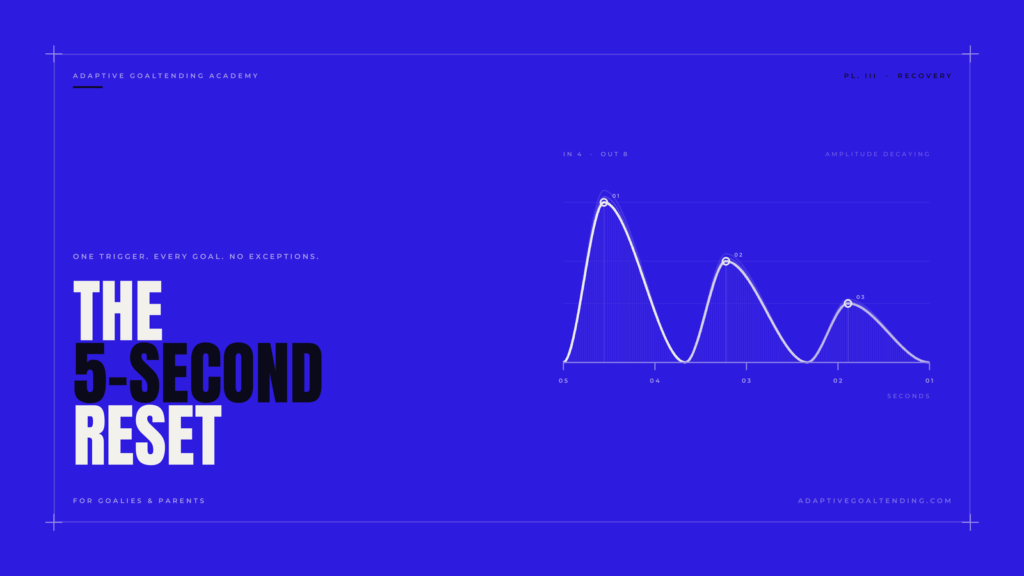
Breathe 4 seconds in, 8 seconds out. Exhaling twice as long as you inhale is scientifically supported as a way to slow your heart rate.
This is the tool for when the reset alone isn’t enough. Three goals in two minutes, a timeout, a dead ball. Four in, eight out, twice. Then back to the cage.
How do you make the reset actually work in a game?
Run it in practice. Every goal, every mistake, including warm-ups and shooting drills. Two weeks, no exceptions.
You are not building a habit for games. You are building one deep enough that a fourth-quarter goal in a tied game can’t override it. If the first time a goalie uses their reset is in a game, it won’t work, and they’ll decide the tool is broken when the truth is they never installed it.
An honest test: over the next two weeks, count how many goals in practice the goalie resigned to without running the cue. Most are surprised by the number.
What should coaches and parents do after a goal?
Leave them alone. The position is already mentally demanding and already carries significant pressure; adding coaching from the sideline right after a goal guarantees the emotion stays live into the next possession.
Save critique and correction for practice unless something very unusual is happening. Positive reinforcement is the exception and should be constant: cheer the saves, cheer the clears, get the bench in on it.
For parents, one car-ride question: “Did you run your reset?” Not “what happened on that second one?” Rewarding the process is what makes the process stick.
Where to go from here
We offer 1on1 online training. We’ve worked with dozens of goalies in this format for almost 2 years and are confident in its effectiveness for goalies of all skill levels. You can learn more about how this works here: https://adaptivegoaltending.com/virtual-training/
We also offer virtual team goalie training, please contact us directly and we will schedule a call to find the right setup for your team: email connor@adaptivegoaltending.com for more information.
Skeptical? See what other families and teams have to say: https://share.google/spgcNKvLlna9tXGQA
Have Any Questions ?
We know every goalie’s journey is different. If you have questions about training, packages, or what’s best for your game, we’d love to help.